An automated high-bay warehouse stores pallet, tote and carton loads in tall rack structures served by rail-guided stacker cranes under WMS/WCS software control. Instead of forklifts traveling wide aisles and reaching limited heights, cranes move loads horizontally along the aisle and vertically to the required storage level, turning the full vertical volume of a building into organized, traceable storage capacity.
We design and supply turnkey high-bay AS/RS (Automated Storage and Retrieval System) projects, covering rack structure, stacker cranes, conveyor and transfer equipment, control software, safety systems and commissioning. The solution supports manufacturing buffer stores, finished-goods warehouses, distribution centers, bonded warehouses, cold chain facilities and e-commerce reserve storage where capacity density, inventory accuracy and repeatable throughput are priorities.
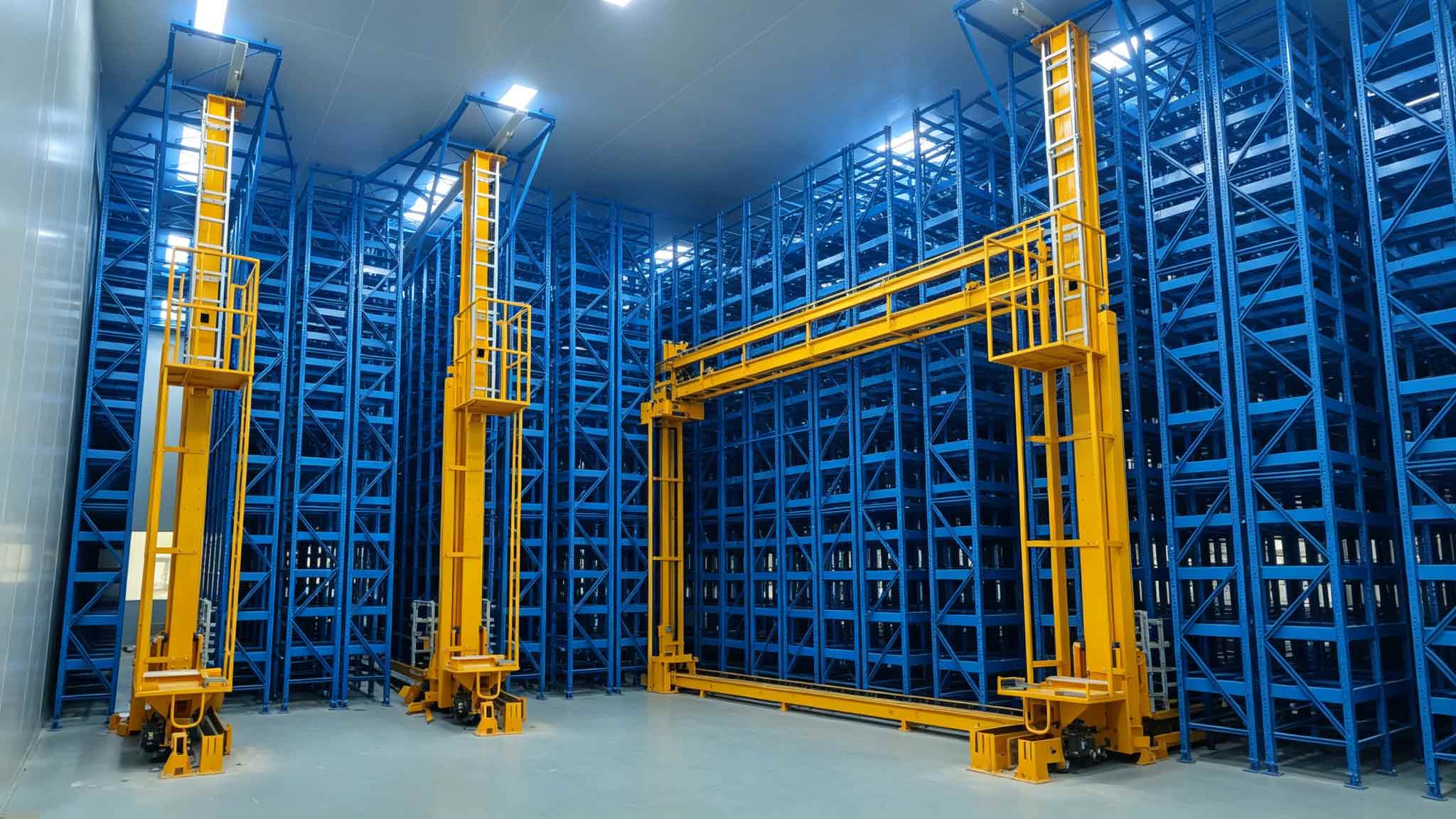
Stacker Cranes — Storage and Retrieval Machines (SRMs)
The stacker crane is the machine that stores and retrieves loads inside each automated aisle. It runs on rail foundations, travels horizontally along the aisle, raises a mast to the target level, and deposits or retrieves the load with precision positioning.
We cover the main crane categories:
- Unit-load pallet SRM: built for full-pallet storage and retrieval in high-bay pallet warehouses; single-mast and double-mast configurations are selected according to load weight, lift height and required cycle speed.
- Mini-load SRM: a lighter, faster crane for totes, trays and cartons, used where small-unit, high-SKU storage is required rather than full-pallet handling.
Crane count, aisle assignment, mast type and carriage equipment are calculated from peak throughput targets, load dimensions and building layout during engineering design.
Conveyor and Transfer System
Loads move between dock areas, workstations, buffer zones and crane pickup/drop-off points through peripheral automation:
- Roller or chain conveyors and transfer cars at rack face and staging zones
- Vertical lifts connecting floor levels or buffer zones
- Interface stations for AGV/AMR, forklift delivery or manual inbound/outbound handling
- Pallet staging, inspection and queue buffers before loads enter the cranes
The transfer system balances crane capacity with dock-side flow so that aisle cranes are not waiting for inbound or outbound staging.
WMS and WCS Software
Two software layers coordinate the automated warehouse:
- WMS (Warehouse Management System): manages stock records, pallet locations, inbound and outbound orders, stock rotation rules (FIFO, FEFO or LIFO), batch and lot traceability, and inventory reporting.
- WCS (Warehouse Control System): dispatches cranes, conveyors and lifts, monitors machine status, queues tasks and coordinates equipment actions in real time.
The AS/RS interface can connect with an existing ERP or warehouse management platform through defined data interfaces; integration scope and communication protocol are confirmed during the project engineering stage.
Safety and Fire Protection Subsystems
High-bay automation includes physical and operational safety for personnel and equipment: safety barriers, aisle access control, maintenance platforms and access procedures, crane speed and position control, and emergency stop circuits across aisles and peripheral equipment.
Fire protection for high-bay storage is designed in line with the applicable building and fire codes of the destination country. Depending on commodity class, rack height and local regulation, this may include overhead or in-rack sprinklers, early-suppression fast-response systems and aspirating smoke detection; the exact arrangement is evaluated against the local fire code, stored commodity type and building design during project planning.
Core Benefits of an Automated High-Bay Warehouse
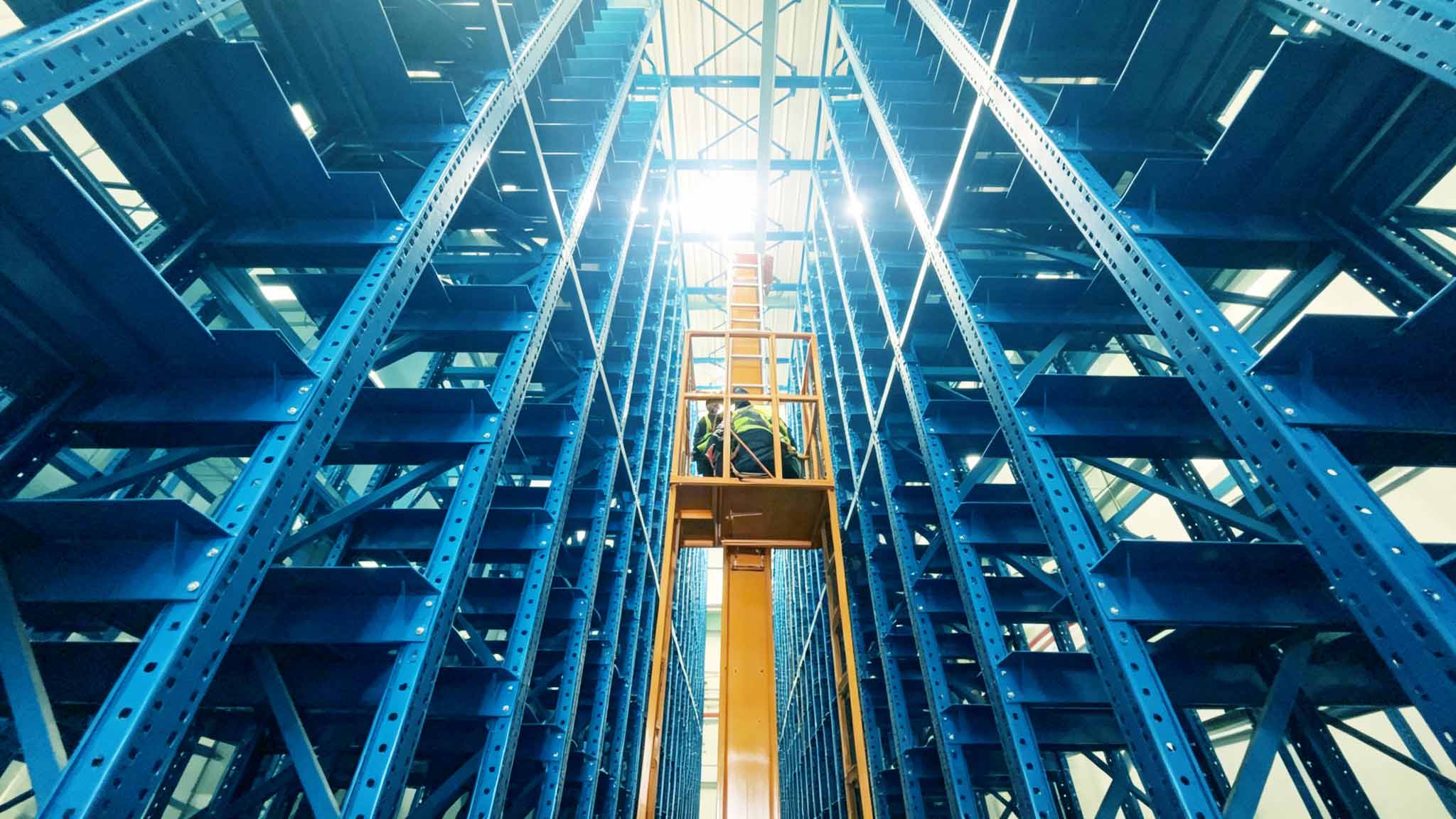
- Denser use of building volume. Tall racking and aisle cranes use the vertical height that forklift-based systems cannot reach, concentrating more storage in the same footprint. The exact capacity gain depends on the original building layout and load specification.
- Reduced repetitive handling labor. Cranes and conveyors replace repeated manual driving and walking, so a smaller operating team can manage a larger, taller facility.
- Real-time inventory visibility. WMS records every pallet movement and location, supporting accurate stock records, batch traceability and controlled FIFO/FEFO/LIFO rotation.
- Consistent, repeatable cycles. Automated equipment repeats inbound and outbound tasks reliably across shifts, including extended operating hours during peak seasons.
- Safer high-level operation. Operators remain outside rack aisles, reducing forklift collision, fall and manual handling risks.
- Controlled goods environment. Enclosed automated zones reduce exposure to dust, unauthorized access and environmental fluctuation, which is particularly relevant for cold storage, bonded and controlled inventory.
- Scalable phasing. Additional aisles, cranes or peripheral equipment can be added in later phases as volume grows, matching investment to demand.
- Long-term operational cost control. The system reduces dependence on extra leased floor space and lowers repetitive handling, damage and write-off exposure; project-level payback is calculated against your specific rent, labor and throughput baseline.
Industries and Applications We Serve
- Manufacturing plants: raw material buffers, finished-goods high-bay warehouses and production-line supply
- Food, beverage and cold chain: chilled and frozen pallet storage with controlled stock rotation
- E-commerce and retail distribution: reserve stock and high-throughput automated storage supporting order fulfillment
- Automotive, electronics and machinery: component kitting, spare parts and finished goods warehousing
- Chemicals, packaging and building materials: uniform palletized bulk storage
- Bonded and customs warehouses: controlled, traceable high-density storage
Before layout drawings and a quotation, our engineering team collects the following inputs:
- Load specification. Pallet or tote dimensions, unit load weight, load stability, pallet type, overhang and irregular cargo conditions.
- Inventory profile. Number of SKUs, fast- and slow-moving share, required rotation rule, batch or lot tracking requirements and order-picking mode.
- Throughput profile. Monthly inbound and outbound volumes, peak hourly pallet or tote cycles, number of shifts and required automation level.
- Building conditions. Clear height, column grid, door positions, floor load capacity, floor flatness, seismic/wind conditions and existing enclosure status.
- Environmental conditions. Temperature range, cold or frozen operation, dust, humidity, and any explosive or clean-room requirements.
- Systems integration. Existing WMS/ERP platforms, required data interfaces and communication standards.
- Budget and phasing. Initial investment level, expected later expansion and whether the project is a new building or an existing-site retrofit.
Based on these inputs we prepare CAD layouts, capacity and throughput calculations, crane and aisle configuration options, and a comparative engineering proposal.